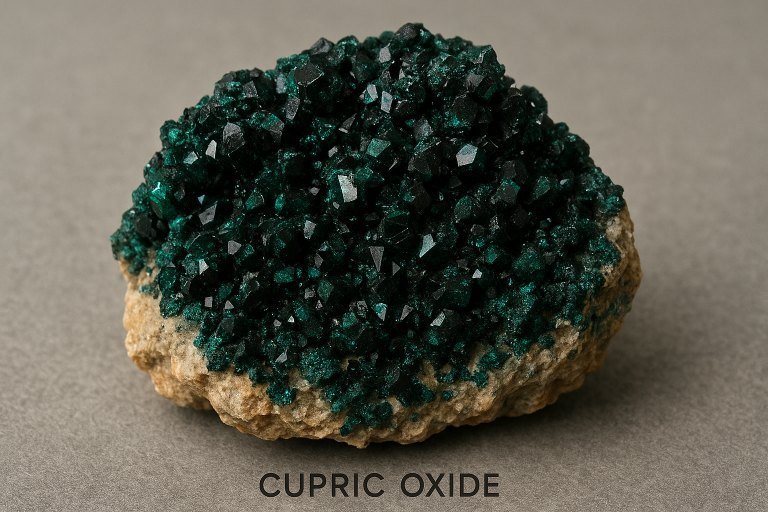
Cupric oxide, also known as copper(II) oxide or CuO, is a significant inorganic compound with a wide range of applications in industrial, chemical, and research fields. This black, solid material is one of the two stable oxides of copper, the other being cuprous oxide (Cu2O). With its unique chemical and physical properties, cupric oxide plays a crucial role in various processes, from catalysis to electronics. This article provides an in-depth exploration of cupric oxide, detailing its characteristics, production methods, applications, and safety considerations. Whether you are a researcher, engineer, or industry professional, this guide offers a thorough understanding of this essential compound.
Overview of Cupric Oxide
Cupric oxide (CuO) is a chemical compound composed of copper and oxygen, with a molar mass of 79.545 g/mol. It appears as a black or dark brown powder and is insoluble in water. Naturally occurring as the mineral tenorite, cupric oxide is often produced industrially for various applications. It exhibits a monoclinic crystal structure and is known for its stability under ambient conditions. Its melting point is approximately 1,326°C, and it decomposes at higher temperatures, releasing oxygen. This compound is amphoteric, meaning it can react with both acids and bases, forming corresponding copper salts.
CuO is a p-type semiconductor with a narrow bandgap of about 1.2–1.9 eV, making it valuable in electronic and optoelectronic applications. Its chemical stability and high thermal conductivity further enhance its utility in diverse fields. Understanding the fundamental properties of cupric oxide is essential for leveraging its potential in practical scenarios, and the following sections will dive deeper into its synthesis, properties, and uses.
Chemical and Physical Properties of Cupric Oxide
The properties of cupric oxide are central to its functionality across various applications. Below is a detailed examination of its key characteristics:
- Chemical Formula: CuO
- Molecular Weight: 79.545 g/mol
- Appearance: Black or dark brown powder
- Crystal Structure: Monoclinic
- Density: 6.31 g/cm³
- Melting Point: 1,326°C (decomposes)
- Solubility: Insoluble in water; soluble in acids and ammonium hydroxide
- Bandgap: 1.2–1.9 eV (p-type semiconductor)
Cupric oxide is thermally stable under normal conditions but decomposes to cuprous oxide and oxygen when heated above 1,000°C in an oxygen-deficient environment. It is resistant to corrosion and exhibits low solubility in water, which makes it suitable for applications requiring durability. Its amphoteric nature allows it to react with acids to form copper salts and with bases to form complex compounds like tetrachlorocuprate. These properties underpin its use in catalysis, pigmentation, and electronic components.
Synthesis Methods of Cupric Oxide
Cupric oxide can be synthesized through various methods, depending on the desired purity, particle size, and application. The most common techniques are outlined below:
Thermal Decomposition
One of the simplest methods to produce cupric oxide is through the thermal decomposition of copper salts such as copper nitrate, copper carbonate, or copper hydroxide. For instance, heating copper(II) nitrate at temperatures between 180–200°C results in the formation of CuO, nitrogen dioxide, and oxygen. The reaction is as follows:
2Cu(NO3)2 → 2CuO + 4NO2 + O2
This method is widely used in industrial settings due to its simplicity and cost-effectiveness, although it requires careful control to avoid contamination from byproducts.
Direct Oxidation of Copper
Another common approach involves the direct oxidation of copper metal in the presence of oxygen at high temperatures (above 300°C). The reaction produces a thin layer of cupric oxide on the copper surface:
2Cu + O2 → 2CuO
This method is often used to create CuO coatings or films for specific applications, such as in electronics or corrosion protection.
Chemical Precipitation
Chemical precipitation involves the reaction of copper salts (e.g., copper sulfate) with a base like sodium hydroxide to form copper hydroxide, which is then heated to produce cupric oxide. The reaction sequence is:
CuSO4 + 2NaOH → Cu(OH)2 + Na2SO4
Cu(OH)2 → CuO + H2O (upon heating)
This method allows for better control over particle size and morphology, making it suitable for producing nanostructured CuO for advanced applications.
Industrial and Research Applications of Cupric Oxide
Cupric oxide finds extensive use in both industrial and research contexts due to its versatile properties. Some of the primary applications include:
Catalysis
CuO is widely employed as a catalyst or catalyst precursor in chemical reactions, such as the oxidation of carbon monoxide and hydrocarbons. It is also used in the water-gas shift reaction, where it facilitates the conversion of carbon monoxide and water into carbon dioxide and hydrogen. Its high surface area and redox properties make it an effective catalyst in environmental and energy applications.
Pigments and Ceramics
In the ceramics industry, cupric oxide is used as a pigment to impart blue, green, or black colors to glazes and glass. Its thermal stability ensures that the color remains consistent even at high firing temperatures. Additionally, it is used in the production of copper-based enamels and coatings.
Electronics and Semiconductors
As a p-type semiconductor, cupric oxide is utilized in the fabrication of solar cells, gas sensors, and photodetectors. Its narrow bandgap allows it to absorb visible light, making it a candidate for photovoltaic applications. CuO nanoparticles are also explored for use in lithium-ion battery anodes due to their high theoretical capacity (674 mAh/g).
Antimicrobial Agent
Cupric oxide exhibits antimicrobial properties, making it useful in coatings and materials designed to prevent bacterial and fungal growth. It is often incorporated into paints, textiles, and medical devices to enhance hygiene and durability.
Safety and Handling Considerations for Cupric Oxide
While cupric oxide is a stable compound under normal conditions, proper handling and safety measures are essential to minimize health and environmental risks. Below are key considerations:
| Hazard Type | Description | Precaution |
|---|---|---|
| Inhalation | Dust or fumes may irritate respiratory tract | Use dust masks or respirators in poorly ventilated areas |
| Skin/Eye Contact | May cause irritation upon prolonged exposure | Wear protective gloves and safety goggles |
Cupric oxide is classified as harmful if swallowed or inhaled in large quantities. It is also toxic to aquatic life, so disposal must comply with environmental regulations. Storage should be in a cool, dry place away from strong acids and reducing agents to prevent unwanted reactions. Safety data sheets (SDS) should always be consulted before handling CuO in industrial or laboratory settings.
Environmental Impact of Cupric Oxide
The production and use of cupric oxide can have environmental implications if not managed properly. Copper compounds, including CuO, are toxic to aquatic organisms and can accumulate in water bodies, disrupting ecosystems. Industrial processes involving CuO should incorporate waste treatment systems to prevent contamination. Additionally, recycling copper from used materials can reduce the demand for raw resources and minimize environmental impact. Regulatory guidelines, such as those from the Environmental Protection Agency (EPA), often dictate permissible exposure limits and disposal methods for copper compounds.
Conclusion
Cupric oxide (CuO) is a multifaceted compound with significant importance in industrial, chemical, and technological domains. Its unique properties, including thermal stability, semiconducting behavior, and catalytic activity, make it indispensable in applications ranging from electronics to environmental protection. By understanding its synthesis methods, properties, and safety considerations, professionals can harness the potential of cupric oxide while mitigating risks. This comprehensive guide serves as a valuable resource for anyone seeking detailed, technical information on this essential material.