Gold oxide, a lesser-known compound of the precious metal gold, has garnered attention in various scientific and industrial fields due to its unique chemical and physical properties. While gold is often celebrated for its inert nature and aesthetic appeal, gold oxide reveals a different facet of this element, showcasing its potential in catalysis, electronics, and nanotechnology. This article provides a detailed examination of gold oxide, covering its chemical composition, synthesis methods, properties, and applications. With a focus on technical accuracy and comprehensive insights, this piece aims to serve as a valuable resource for researchers, engineers, and enthusiasts alike.
Chemical Composition and Structure of Gold Oxide
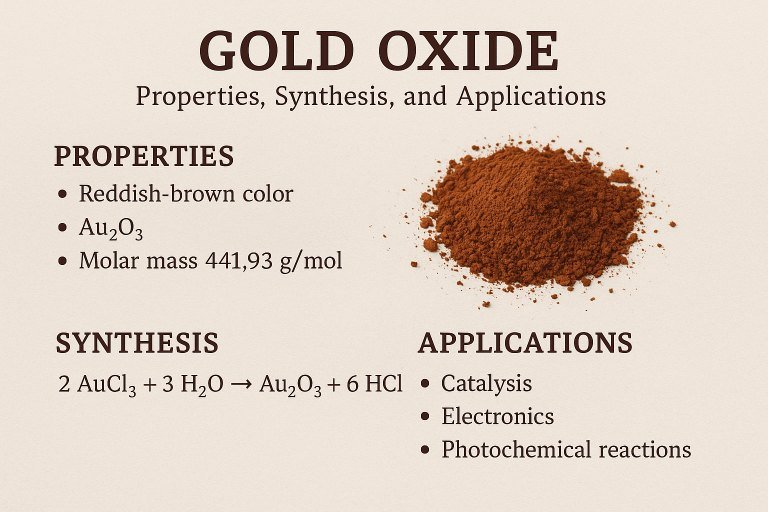
Gold oxide primarily exists in two stable forms: gold(III) oxide (Au₂O₃) and gold(I) oxide (Au₂O). Gold(III) oxide is the more common and stable form, often appearing as a dark brown or black powder. It consists of gold in the +3 oxidation state, bonded to oxygen atoms in a crystalline structure. Gold(I) oxide, on the other hand, features gold in the +1 oxidation state and is less stable, often decomposing under certain conditions.
The structure of Au₂O₃ has been studied using X-ray diffraction techniques, revealing a complex lattice where gold atoms are coordinated with oxygen in a manner that contributes to its semiconductor-like properties. The compound's molecular formula indicates a stoichiometric ratio of two gold atoms to three oxygen atoms, and its molar mass is approximately 441.93 g/mol. Understanding the chemical composition and structure of gold oxide is fundamental to exploring its reactivity and potential applications.
Synthesis Methods for Gold Oxide
The preparation of gold oxide requires precise control over reaction conditions to ensure purity and desired oxidation states. Several methods have been developed for synthesizing gold oxide, each tailored to specific research or industrial needs. Below are the primary synthesis approaches:
- Direct Oxidation: This method involves heating gold in an oxygen-rich environment at elevated temperatures (typically above 200°C). However, due to gold's inert nature, direct oxidation often requires catalysts or plasma assistance to facilitate the formation of Au₂O₃.
- Chemical Precipitation: Gold oxide can be synthesized by reacting gold salts, such as gold(III) chloride (AuCl₃), with alkaline solutions like sodium hydroxide (NaOH). This process results in the precipitation of Au₂O₃, which can be filtered and dried for further use.
- Thermal Decomposition: Certain gold compounds, when subjected to controlled heating, decompose to form gold oxide. For instance, heating gold hydroxide (Au(OH)₃) at specific temperatures (around 250°C) yields Au₂O₃ through dehydration and decomposition.
Each synthesis method has specific parameters, such as temperature ranges, reaction times, and pH levels, that must be optimized to achieve high yields and purity. For instance, in chemical precipitation, maintaining a pH of 8-10 during the reaction ensures better control over the particle size and morphology of the resulting gold oxide.
Physical and Chemical Properties of Gold Oxide
Gold oxide exhibits a range of physical and chemical properties that distinguish it from elemental gold and other metal oxides. These properties are critical to understanding its behavior in various environments and applications. Some key characteristics include:
| Property | Gold(III) Oxide (Au₂O₃) |
|---|---|
| Appearance | Dark brown to black powder |
| Melting Point | Decomposes at ~160°C |
| Density | Approximately 11.34 g/cm³ |
| Solubility | Insoluble in water; soluble in acids like HCl |
| Electrical Conductivity | Semiconductor-like behavior |
Chemically, gold oxide is amphoteric, meaning it can react with both acids and bases. For example, Au₂O₃ dissolves in hydrochloric acid to form gold(III) chloride and water, while it reacts with strong bases to form aurates. Additionally, gold oxide is thermally unstable, decomposing into elemental gold and oxygen gas when heated above 160°C. This property limits its use in high-temperature environments but makes it suitable for specific catalytic processes where controlled decomposition is desired.
Applications of Gold Oxide in Industry and Research
Despite being less common than other metal oxides, gold oxide has found niche applications across various domains due to its unique properties. Below are some of the key areas where gold oxide plays a significant role:
Catalysis
Gold oxide, particularly in the form of nanoparticles, is widely studied for its catalytic properties. It is effective in facilitating reactions such as carbon monoxide oxidation and alcohol oxidation. The high surface area of gold oxide nanoparticles enhances their catalytic efficiency, making them valuable in environmental applications like air purification systems.
Electronics and Sensors
Due to its semiconductor-like behavior, gold oxide is explored for use in electronic devices and sensors. It can be integrated into gas sensors for detecting harmful gases like carbon monoxide and nitrogen oxides, where its sensitivity to surface reactions is a key advantage. Additionally, gold oxide thin films are investigated for potential use in optoelectronic devices.
Nanotechnology
In nanotechnology, gold oxide serves as a precursor for fabricating gold nanoparticles, which are widely used in medical diagnostics, drug delivery, and imaging. The controlled reduction of gold oxide allows for the precise tuning of nanoparticle size and shape, which are critical parameters in determining their functionality.
Chemical Synthesis
Gold oxide is also utilized as a reagent in organic and inorganic synthesis. Its ability to act as an oxidizing agent makes it useful in specific chemical transformations, particularly in the synthesis of complex gold-containing compounds.
Stability and Storage Considerations for Gold Oxide
Gold oxide, particularly Au₂O₃, requires careful handling and storage to maintain its chemical integrity. Due to its thermal instability, it should be stored at temperatures below 100°C to prevent decomposition. Exposure to moisture and light can also affect its stability, so it is typically stored in airtight containers under dry conditions. Furthermore, when working with gold oxide in laboratory or industrial settings, appropriate safety measures must be taken, as its fine powder form can pose inhalation risks if not handled properly.
In terms of chemical stability, gold oxide is relatively resistant to mild environmental conditions but can react with strong acids and bases. Therefore, compatibility with other materials and chemicals in its storage or application environment must be assessed to avoid unintended reactions.
Environmental and Safety Aspects of Gold Oxide
While gold oxide is not classified as highly toxic, its environmental and safety aspects warrant consideration. As a fine particulate material, it can contribute to respiratory irritation if inhaled in significant quantities. Proper personal protective equipment, such as masks and gloves, is recommended during handling. From an environmental perspective, the disposal of gold oxide and gold-containing waste must comply with local regulations to prevent contamination, given the value and potential reactivity of gold compounds.
Additionally, during synthesis or application processes involving gold oxide, energy consumption and by-product generation should be monitored to minimize environmental impact. While gold oxide itself does not pose significant ecological risks, sustainable practices in its production and use are encouraged to align with broader environmental goals.
Future Research Directions for Gold Oxide
The study of gold oxide continues to evolve as researchers uncover new properties and potential applications. Areas of interest include the development of more efficient synthesis methods to reduce costs and improve scalability. Additionally, the exploration of gold oxide in advanced materials, such as hybrid nanocomposites, holds promise for enhancing its functionality in electronics and catalysis.
Another avenue of research focuses on stabilizing gold oxide under varying conditions to expand its practical utility. By addressing its thermal and chemical instability through doping or surface modifications, scientists aim to unlock new possibilities for this compound in high-performance applications.